
Table of Contents
- Why Third-Party Verification Beats Brand Claims
- What the Main Organic Cotton Certification Bodies Actually Cover
- How to Use the GOTS Certification Database Step by Step
- What Is the OCS Organic Content Standard?
- How to Spot Fake Organic Cotton Labels
- Checking Transaction Certificates and Licence Numbers
- Common Mistakes When Verifying Organic Cotton Certification
- Conclusion
- Frequently Asked Questions
Last Updated: 17 September 2026
Why Third-Party Verification Beats Brand Claims
Learning how to verify organic cotton certification matters because a "100% organic" label printed by the brand itself is a marketing claim, not proof. Only an independent certification body can confirm that cotton was grown, processed and handled to a recognised organic standard. At Plym Club Clothing, we publish our certification details precisely because shoppers should be able to check them, not take our word for it.
That distinction is the whole game. A brand can print anything on a neck label. A certification body issues a licence number that anyone can look up in a public database, and that database is where the real verification happens.
What the Main Organic Cotton Certification Bodies Actually Cover
Certification bodies differ mainly in scope: some cover the entire supply chain from field to finished garment, while others verify only the fibre content. Knowing which type you are looking at tells you how much of the product's story is actually verified.
- GOTS (Global Organic Textile Standard): full supply chain, organic fibre plus social and chemical processing criteria
- OCS (Organic Content Standard): fibre content only, tracked from source to final product
- OEKO-TEX Standard 100: tests for harmful substances, not organic origin
- PETA-Approved Vegan: confirms no animal-derived materials, unrelated to organic status
The pattern to remember: only GOTS verifies the whole chain. The rest confirm a single attribute.
GOTS: The Full Supply Chain Standard
GOTS is the most demanding of the mainstream standards. It requires a minimum organic fibre content, restricts which chemicals can be used in processing, and sets social criteria for workers along the chain. Every stage, from ginning to final packaging, must hold its own GOTS certification for the finished item to carry the GOTS label. That chain-of-custody requirement is what separates a genuine GOTS claim from a vague "made with organic cotton" statement.
OCS and Other Single-Issue Standards
OCS verifies that a stated percentage of organic material is present and tracked through the supply chain. It says nothing about chemical inputs, water use or labour conditions. A garment can hold a valid OCS certificate and still be processed with conventional chemistry. Treat OCS as a fibre-content check, not a sustainability guarantee.
How to Use the GOTS Certification Database Step by Step
The GOTS certification database is a public, searchable register of every certified company and product. You look up the licence number printed on the garment or its packaging, confirm the company appears, and check that the certified product category matches what you are holding. It takes a couple of minutes.
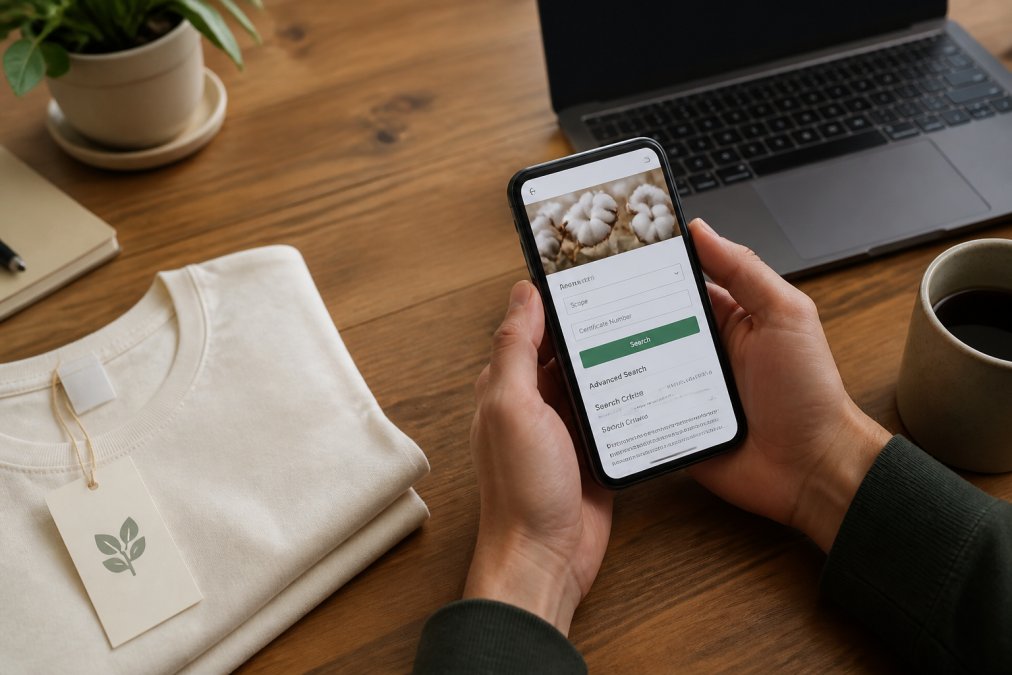
Here is the process, in order:
- Find the licence number on the garment label, swing tag or the brand's website.
- Open the GOTS public database and enter the number.
- Confirm the company name matches the brand you bought from.
- Check the certified product category covers the item in your hand.
- Verify the certificate has not expired.
Expected result: a matching company entry with a current certificate and the correct product category. If any of those four things fails, the claim is unverified.
What Is the OCS Organic Content Standard?
The OCS Organic Content Standard is a voluntary, third-party verification that tracks the percentage of organic material in a product from the source through to the finished item. It confirms content, not processing methods or working conditions.
That narrow scope is deliberate. OCS exists so brands can prove a specific fibre claim without meeting the broader criteria of a full-chain standard. When you see an OCS logo, read the accompanying percentage: "contains 50% organic content" and "contains 95% organic content" are very different claims, and the certificate will state which applies.
How to Spot Fake Organic Cotton Labels
Fake or misleading labels usually fail on the same handful of details. A genuine certification mark carries a licence number, a certifying body's name and a verifiable entry in that body's register. If any of those are missing, the label is decorative.
Watch for these tells:
- A leaf or "eco" logo with no certification body named
- The word "organic" with no standard, no number and no register
- A GOTS or OCS logo with no licence number beneath it
- Certificates that name a supplier rather than the brand selling the garment
- Claims that swap between "organic", "natural" and "sustainable" with no definition
One honest note: vague language is not always deliberate deception. Small brands sometimes repeat a supplier's claim without checking it. Either way, the fix is the same, which is to look the number up yourself.
Checking Transaction Certificates and Licence Numbers
A transaction certificate is the document that links one shipment of certified material to the certified company that bought it. Licence numbers identify the certified company. Together they form the paper trail that makes a claim checkable.
When you ask a brand for proof, ask for both:
| Document | What It Proves | Where to Check It |
|---|---|---|
| Licence number | The company is certified | The certifying body's public register |
| Transaction certificate | A specific shipment was certified | Issued by the certifier to the buyer |
| Scope certificate | Which products and processes are covered | The certifying body's register |
| Product label | The claim being made to you | Cross-reference against the above |
Most shoppers will never need the transaction certificate. But asking whether a brand can produce one separates companies that genuinely hold certification from those that merely mention it.
Common Mistakes When Verifying Organic Cotton Certification
The most common mistake is checking the logo instead of the number. Logos are easy to copy; register entries are not. A second frequent error is assuming one certification covers everything: OEKO-TEX confirms a garment is free from certain harmful substances, which is valuable but entirely separate from organic fibre content.
Three more worth avoiding:
- Trusting a certificate that names the fabric mill but not the brand you bought from
- Assuming an expired certificate is a fake one
- Checking the database once and never again, when certificates lapse and renew
At Plym Club Clothing, our garments carry OEKO-TEX Standard 100 certification and PETA-Approved Vegan status, and we are happy to point customers to the relevant registers so they can confirm both. That is the standard every brand should meet.
Conclusion
Verification is a habit, not a one-off task. The next time a label claims organic cotton, find the licence number, open the certifying body's register, and confirm the entry matches the garment in your hand. If a brand cannot give you a number to check, that tells you something.
Frequently Asked Questions
What are the main organic cotton certifications to look for?
The two you will see most on clothing labels are GOTS and OCS. GOTS covers the whole supply chain, from the farm through processing, dyeing and sewing, and sets limits on chemicals and wastewater. OCS only tracks the percentage of organic fibre in a product, so it says nothing about how the fabric was processed. For a garment, GOTS gives you the fuller picture; OCS confirms fibre content only.
How can I check if a brand's GOTS certification is valid?
Ask the brand for its GOTS licence number or the name of its certified supplier. Then search the GOTS public database on the official GOTS website. You can filter by company name, country or product category. If the brand cannot give you a licence number, or the database returns no match, treat the claim as unverified. A valid certificate also lists the specific products covered, so check the item you want to buy falls within that scope.
What is the difference between GOTS and OCS certification?
GOTS is a full supply chain standard: it covers organic fibre content, processing, chemical inputs, wastewater treatment and social criteria, and requires annual third-party audits at each stage. OCS is narrower. It verifies the percentage of organic material in a finished product through a chain-of-custody check, but it does not regulate dyes, finishes or factory conditions. A product can hold OCS and still be processed with conventional chemicals.
Can I verify organic cotton claims using a transaction certificate?
Yes. A transaction certificate is issued for each shipment of certified material as it moves between suppliers in the chain. It links a specific batch of cotton to a certified source. Brands with a genuine supply chain can request these from their suppliers and share them on request. If a brand cannot produce a transaction certificate for the fabric in a garment, the organic claim has no paper trail behind it.
The gap between what a label claims and what a database confirms is where greenwashing lives. Plym Club Clothing builds its range from 100% organic cotton, made to order to avoid waste, with eco-friendly biodegradable packaging and water-based inks, and we hold OEKO-TEX Standard 100 and PETA-Approved Vegan certification you can check for yourself. Shop now and wear something you can actually verify.