
Table of Contents
- The Green Flags and Red Flags at a Glance
- Common Fashion Greenwashing Tactics to Watch For
- What the Green Claims Code UK Means for Shoppers
- Sustainable Fashion Certifications That Actually Mean Something
- How to Verify Clothing Sustainability Claims Yourself
- What Genuine Sustainable Fashion Looks Like in Practice
- Frequently Asked Questions
Last Updated: September 17, 2026
The Green Flags and Red Flags at a Glance
Learning how to spot fashion greenwashing starts with one simple question: does the brand show proof, or just promise? Fashion greenwashing is the practice of making a company look more environmentally friendly than its actions actually are. It is a growing problem in the UK clothing market, and it costs shoppers real money.
At Plym Club Clothing, we sell organic cotton t-shirts and hoodies, so we have a stake in this. We also know how easy it is to talk a good game without backing it up. This guide shows you how to tell the difference.

Here is the short version:
- Green flag: A named certification with a number you can check.
- Green flag: Specific claims, like "100% organic cotton."
- Green flag: Information about where and how the item was made.
- Red flag: Vague words like "eco-friendly" or "green" with no proof.
- Red flag: One small good deed used to hide a much bigger problem.
- Red flag: No certification, no detail, no way to check anything.
Keep those six points in mind and you will filter out most of the noise. Below, we break down each tactic in detail and show you how to verify a claim in under five minutes.
Common Fashion Greenwashing Tactics to Watch For
Most greenwashing follows a small number of patterns. Once you know them, they are hard to miss.
Vague Language and Meaningless Buzzwords
Words like "eco," "green," "natural," and "conscious" mean almost nothing on a clothing label. There is no legal definition behind them, so any brand can print them.
The Competition and Markets Authority guidance on environmental claims is clear that claims must be truthful and must not hide important information. A jumper described as "sustainable" with no evidence is a claim the brand cannot back up.
Watch for these phrases:
- "Planet-friendly" with no detail
- "Made with recycled materials" but no percentage given
- "Eco collection" where only one item in the range qualifies
- "Better for the environment" compared to what, exactly?
Misleading Imagery and Selective Claims
Greenwashing also hides in pictures. A brand might show a forest, a leaf, or a wind turbine on the tag while the garment itself is made from conventional polyester.
Selective claims are the other trick. A company highlights one small improvement, such as a recycled cardboard box, while ignoring the huge footprint of producing the item itself.
Ask yourself: does the image match the actual product? A leaf logo proves nothing about the cotton inside the shirt.
What the Green Claims Code UK Means for Shoppers
The Green Claims Code is a set of principles from the Competition and Markets Authority that tells businesses how to make environmental claims. It is not a law on its own, but it sits alongside consumer protection rules that the CMA can enforce.
The code asks that claims be truthful, clear, complete, and backed by evidence. It also says a claim must consider the full life cycle of a product, not just one stage.
For shoppers, this matters because it gives you a standard to hold brands against. If a claim is vague or one-sided, it likely fails the code.
The Competition and Markets Authority has been reviewing how fashion brands describe their products, and it has the power to act when claims mislead buyers. You can read the full guidance on the Green Claims Code page and use it as a checklist.
Sustainable Fashion Certifications That Actually Mean Something
A real certification is the fastest way to cut through greenwashing. It is issued by an independent body, not the brand itself, and it comes with a number you can look up.
| Certification | What It Covers | What to Check |
|---|---|---|
| OEKO-TEX Standard 100 | Harmful substances in the finished item | Certificate number on the label |
| GOTS | Organic status of the whole supply chain | Scope certificate and product ID |
| GRS | Recycled content in a material | Transaction certificate |
| Fairtrade | Fair terms for farmers and workers | Licence number |
OEKO-TEX Standard 100
OEKO-TEX Standard 100 tests a finished garment for harmful substances. It is one of the most common textile certifications and one of the easiest to check.
Plym Club Clothing garments carry OEKO-TEX Standard 100 certification, which means the fabric has been tested against a published limit for substances that could affect your health.
Look for the certificate number and enter it on the OEKO-TEX website. If it does not check out, ask the brand why.
GOTS and Other Textile Standards
GOTS, the Global Organic Textile Standard, is the one to know for organic cotton. It covers the whole chain, from the farm to the finished item, and it sets rules for chemical use and working conditions.
A brand claiming "organic cotton" without GOTS or an equivalent certification is asking you to take its word for it. That is exactly what greenwashing relies on.
How to Verify Clothing Sustainability Claims Yourself
You can check most claims in under five minutes. Verification is the single most useful skill in this whole guide, so it is worth building the habit.
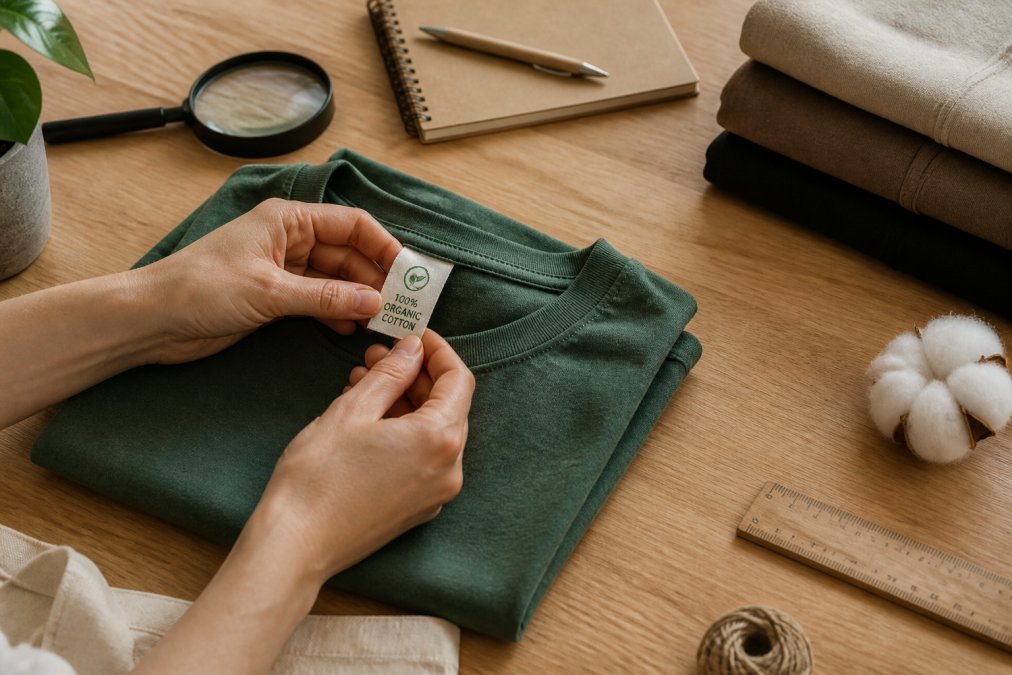
Follow these steps:
- Find the certification number. Look on the label, the tag, or the product page.
- Search the certifier's site. OEKO-TEX, GOTS, and GRS all have public lookup tools.
- Check the claim against the product. Does "organic" apply to the whole item or just the trim?
- Look for a percentage. "Made with recycled cotton" means little without a figure.
- Read the care and materials page. Real detail is a good sign. Silence is not.
- Ask the brand directly. A brand with nothing to hide will answer clearly.
What Genuine Sustainable Fashion Looks Like in Practice
Real sustainable fashion is boring to look at on paper. It is specific, it is checkable, and it usually admits what it has not solved yet.
Here is what we look for at Plym Club Clothing when we assess any brand, including our own:

- Made-to-order production, so nothing is made that nobody wants
- 100% organic cotton, named as such, not "natural fibres"
- Water-based inks rather than plastisol
- Biodegradable packaging, stated plainly
- OEKO-TEX Standard 100 certification on the fabric
- PETA-approved vegan status where relevant
- A clear statement of what the brand is still working on
You can see this approach in our Plym Club 'One Planet One Crew' T-Shirt and our Plym Club ‘Made For The Future’ Hoodie, both made to order from heavier-knit organic ring spun cotton.
The test is simple. If a brand cannot name its certifications, its materials, and its production method, it is asking you to trust a feeling rather than a fact. That is the line between real effort and fashion greenwashing.
Frequently Asked Questions
What are the most common examples of fashion greenwashing?
Vague terms like 'eco-friendly' or 'conscious' without evidence, a single green product line used to imply the whole brand is sustainable, and imagery of forests or oceans that has no connection to how the garment was made. Another common example is a recycled content claim on a tag without stating what percentage is recycled or where the material came from. If a claim cannot be checked, treat it as marketing rather than fact.
How does the Competition and Markets Authority regulate green claims?
The CMA enforces the Green Claims Code, which requires that environmental claims be truthful, clear, complete and substantiated. It applies to all businesses making green claims to consumers, including fashion brands. The CMA can investigate misleading claims and has powers under consumer protection law to take action against companies that break the rules. If a brand's claims feel vague or unverifiable, the Code gives you a clear framework to judge them against.
What should I look for on a clothing label to ensure it is genuinely sustainable?
Look for specific, named certifications such as OEKO-TEX Standard 100, GOTS or other recognised textile standards. Check that the fibre content is stated clearly, for example '100% organic cotton' rather than just 'organic'. A label that names a certification body and a standard number is far more credible than one that simply says 'sustainable' or 'green'. You can then verify that certification independently on the body's own website.
How can I verify a brand's sustainability claims independently?
Start by checking whether the brand names specific certifications and then look those up on the certifying body's website. Search for the brand's sustainability page and see whether it provides measurable details, such as energy use, water savings or audit results, rather than general statements. You can also check the CMA's Green Claims Code guidance to see what a compliant claim should include. If a brand cannot show you the evidence, that is your answer.
Spotting greenwashing takes a few minutes of checking, and it saves you from paying a premium for a label that means nothing. Plym Club Clothing makes that check easy: 100% organic cotton, made-to-order production to avoid waste, OEKO-TEX Standard 100 certification, and biodegradable packaging on every order. Shop now and wear something you can actually verify.